Every business owner asks the same two questions before they hire anyone. How much is this going to cost, and how do I know it is working.
The first question is easier to answer than most agencies pretend. The second is where budgets quietly go to waste.
What has changed in 2026 is the price of competing. Australian businesses are not just deciding whether to invest in digital marketing anymore. They are deciding how to keep pace in a market where more advertisers are bidding on the same audiences, and where a growing share of search results never produce a click at all.
What Australian businesses are actually spending
Start with the market numbers, because they tell you what you are up against.
The IAB Australia Internet Advertising Revenue Report, prepared by PwC Australia, put total internet advertising expenditure at $4.9 billion for the March quarter of 2026. That is up 15.3 per cent on the same quarter a year earlier, and it sits within one per cent of the record December 2025 quarter. IAB Australia noted that the usual seasonal drop off in the first quarter has effectively disappeared.
For the full calendar year, the market reached $18.4 billion in 2025, growing 11.5 per cent year on year, with search advertising alone hitting $8.0 billion.
Two things stand out for smaller advertisers.
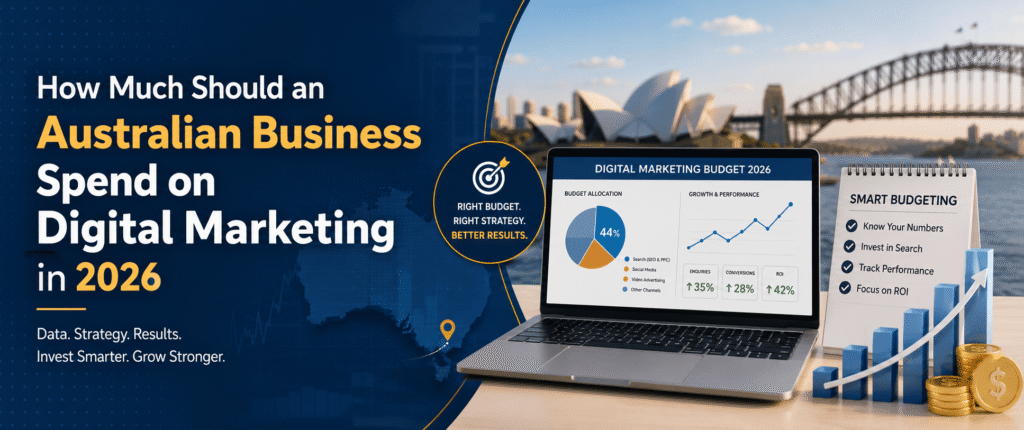
- Search and Directories still commands roughly 44 per cent of all Australian digital ad spend, and grew 13.9 per cent year on year in Q1 2026. Search is not being replaced. It is getting more expensive.
- IAB Australia's chief executive pointed to growth coming from a broader base of advertisers than before. More competitors, same auction.
Meanwhile the audience is fully saturated. DataReportal's Digital 2026 Australia report counted 26.2 million internet users at the end of 2025, or 97.1 per cent of the population. There are no new Australians coming online. Every new customer you win is one somebody else lost.
The rule of thumb, and why it falls over
You will see the same figure quoted everywhere. Spend 5 to 10 per cent of revenue on marketing.
We are not going to pretend that number has solid Australian evidence behind it. It circulates widely in marketing circles, it is usually drawn from overseas survey data, and it ignores almost everything that determines what a business actually needs to spend.
Consider two Melbourne businesses with identical revenue. One is an established plumbing company with 400 reviews, a fifteen year old website and a phone that already rings. The other is a new commercial fit out firm with no reviews, no rankings and no brand recognition. The same percentage of revenue produces completely different outcomes.
Percentage rules are a starting point for a conversation. They are not a plan.
A better way to set the number
Work from the outcome you need rather than the revenue you have
Start with your customer maths
Three numbers give you a defensible budget:
- Average customer value. What a client is worth to you over the life of the relationship, not just the first invoice.
- Close rate. How many enquiries turn into paying customers.
- Growth target. How many additional customers you need in the next twelve months.
If a customer is worth $4,000, you close one enquiry in four, and you want 50 more customers this year, you need 200 enquiries. Now the question becomes what it costs to generate 200 enquiries in your market, which is something an agency can actually estimate from real auction and search data rather than guesswork.
Then check it against what you can afford to pay
Divide your acceptable acquisition cost by your close rate and you have a ceiling on cost per enquiry. If the market rate for a lead in your category sits above that ceiling, the answer is not a bigger budget. The answer is a better website, a stronger offer, or a different channel.
That is the conversation worth having before anyone spends a dollar on ads.
Where the budget should go in 2026
Splitting a budget by channel is where most businesses get it wrong, usually by funding the channel they find most interesting rather than the one that carries the most weight.
Fix the foundations before funding traffic
If your site is slow, unclear or difficult to enquire through, every channel you fund performs worse than it should. Paid traffic to a weak page is the most expensive mistake in digital marketing, because you pay for the click either way.
Foundations means a fast, well structured website, conversion tracking that actually fires, and a complete Google Business Profile. These are usually one off or low cost items, and they lift the return on everything that follows.
Give search the largest ongoing share
There is a reason search takes 44 per cent of the national ad market. It captures people who have already decided they want what you sell.
For most Australian service businesses, we would put the largest recurring allocation into search visibility work, covering technical health, service page quality and content that answers real customer questions. It compounds. A page that ranks this year usually still ranks next year, which is not true of an ad that stops the moment the budget does.
If your customers are geographically bound, treat local search presence as part of that same allocation rather than an optional extra. Map results and Google Business Profile visibility drive a large share of enquiries for trades, clinics, hospitality and professional services.
Use paid to buy speed, not to replace strategy
Google Ads campaigns do one thing organic cannot. They produce enquiries this week.
That makes paid the right tool for new businesses, new service lines, seasonal pushes and testing which messages convert before you commit to writing thirty pages around them. It is the wrong tool as a permanent substitute for organic visibility, because the cost per lead rarely falls over time and the traffic stops when you stop paying.
We have written a longer comparison of how SEO and Google Ads returns differ if you want to go deeper on the trade off.
Treat video and social as demand creation
Video was the fastest growing major segment in Q1 2026, up 20.4 per cent year on year to $1.4 billion. It works, but it works differently. Video and social create demand among people who were not looking for you. Search captures demand that already exists.
Fund demand capture first. Add demand creation once the capture side is working, otherwise you are sending interested people to a business they cannot find when they go looking.
What to cut first when budgets tighten
Australian marketers are cautious right now for good reason. IAB Australia's 2026 Video State of the Nation report found 48 per cent of agency leaders named the economy as their leading concern, ahead of measurement and AI.
When something has to go, cut in this order:
- Channels you cannot attribute to enquiries
- Broad awareness activity with no capture mechanism behind it
- Tools and subscriptions nobody has opened in three months
- Ad spend on keywords that generate clicks but not calls
Cut foundations last. A neglected website costs more to repair than it does to maintain.
The mistake that wastes more money than any channel choice
The same IAB report found one in four agencies rarely or never unify effectiveness measurement across screens, even though nine in ten plan campaigns across them. If the people doing this professionally struggle with it, the average business running its own tracking has very little chance.
Practical version for a small or mid sized business:
- Every enquiry form, phone number and booking link is tracked
- You can see which channel produced each enquiry, not just each session
- Someone records which enquiries became customers and reports that back
- Reporting is monthly and in plain English
Without that loop, budget decisions are guesses dressed up as strategy. With it, the budget question mostly answers itself, because you can see what a customer costs from each channel and buy more of the cheap ones.
Working out the right number for your business
Cubic Digital works with businesses across Australia from our Melbourne base, and the first conversation is almost always about this. Not which package to buy, but what a customer is worth, what one currently costs to win, and which gap in the setup is holding the rest back.
If you want a realistic view of what your goals would cost and where your current spend is leaking, book a free strategy session and we will walk through the numbers with you.