If your organic traffic is down but your enquiries are steady, you are not imagining things and your SEO is probably not broken.
Something more awkward is happening. Google is answering more questions on its own results page, which means people see your business without ever landing on your site. Until recently there was no way to prove that in a report. You could see the traffic drop. You could not see the visibility that replaced it.
That gap started closing on 3 June 2026.
What Google actually launched
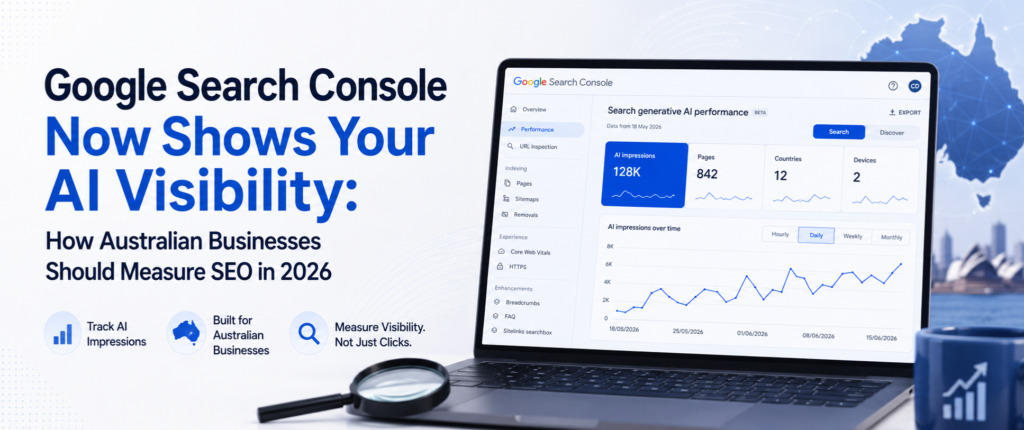
Google announced new Search generative AI performance reports in Search Console, with dedicated views for both Search and Discover. For the first time, site owners can see how often their pages appear inside generative AI features such as AI Overviews and AI Mode.
Here is what the report gives you:
- Impressions inside generative AI features across Search and Discover
- Pages, so you can see which specific URLs are being picked up
- Countries, which matters if you serve both Australian and overseas markets
- Devices
- Performance over time, with hourly, daily, weekly and monthly granularity
Data begins from 18 May 2026 with no historical backfill, so there is nothing to compare against before that date.
Google also confirmed this is not new data collection. These impressions were already counted inside the overall performance report. The new view simply separates them out, which means your existing totals have not changed.
What the report does not give you
This is the part worth being clear about, because a few write ups have oversold it.
There is no click data. No click through rate. No average position. No query level breakdown.
You can see that a page appeared inside an AI generated answer. You cannot see what someone searched to trigger it, whether they clicked through afterwards, or where in the answer your content sat. Google has signalled that more is coming without committing to a date.
The rollout also started narrow, limited to a subset of UK site owners with a wider global rollout to follow. Australian site owners may not have access yet. That does not make the change irrelevant here, because it tells you exactly which metric Google intends to make standard, and you can build your reporting around it now.
Why this matters more in Australia than people realise
Australians have been using AI search for close to a year already. Google began rolling out AI Mode in Australia in October 2025, part of an expansion to more than 40 countries.
At Google I/O in May 2026, the company said AI Mode had passed one billion monthly users and that total Search queries had reached an all time high. Search demand is not shrinking. The click is just no longer guaranteed.
Add the market context. DataReportal's Digital 2026 Australia report counted 26.2 million internet users at the end of 2025, at 97.1 per cent penetration. There is no untapped audience left to grow into. If your visibility falls, a competitor picked it up.
So the practical question for an Australian business in 2026 is not whether AI search has affected you. It is whether your reporting can tell you.
The metrics that still matter
Sessions and rankings are not useless. They are just no longer sufficient on their own. Here is the set we would build a monthly SEO report around now.
1. Enquiries by channel, not sessions
The only number that survives every algorithm change is how many qualified enquiries organic search produced. If your traffic fell 20 per cent and your organic enquiries held steady, your SEO is working and your reporting was measuring the wrong thing.
Track form submissions, phone calls and booking requests with the source attached. Then get someone to record which of those became customers.
2. Impressions and share of visibility
Impressions are becoming more important than clicks as a leading indicator. If impressions are rising while clicks fall, you are still being seen and the answer is being satisfied on the results page. If impressions fall too, that is a genuine visibility problem worth fixing.
3. Branded search volume
When people read about you in an AI answer and then search your business name later, that shows up as branded search growth. It is one of the cleanest available proxies for AI visibility that is not clicking through. Watch the trend over quarters rather than weeks.
4. Presence in AI answers, checked manually
Until the Search Console report reaches Australia, check it yourself. Run your ten most commercially important queries in AI Mode from a logged out session and record whether your business is named. It takes twenty minutes a month and gives you a baseline nobody else in your category is bothering to build.
5. Rankings, still, for the queries that convert
Track fewer keywords more carefully. Ten commercial terms that produce enquiries beat two hundred vanity terms that produce a nice looking chart.
The opt out control, and why most businesses should ignore it
Alongside the reports, Google added a control letting site owners block their content from appearing in AI features. Google began honouring it on 17 June 2026, and confirmed two things about it.
Opting out means you receive no traffic and no impressions from generative AI features. It will not harm your rankings in standard search results.
Publishers with a licensing argument may have reasons to consider it. For an Australian service business, we would not. Being absent from the surface where a growing share of research happens is a strange way to protect visibility. The better response is to be the source those answers draw from.
What actually earns a mention in AI answers
None of this changes the underlying work as much as the headlines suggest. What it changes is which parts of the work matter most.
- Answer questions directly and early on the page. Content that buries the answer under four hundred words of preamble is harder for a model to extract cleanly.
- Be specific and verifiable. Real prices, real service areas, real process detail. Vague marketing copy gives an AI system nothing to cite.
- Build entity clarity. Consistent business name, address and phone details across your site, your Google Business Profile and every directory listing.
- Keep structured data accurate. Organisation, LocalBusiness, FAQ and Service markup help systems understand what you do without guessing.
- Publish content only you could write. Australian pricing, local regulation, regional conditions and genuine process detail are harder to summarise away than generic advice.
We covered the broader shift in how search results are being generated in our earlier piece on how AI is changing Google Search, and the terminology around it in our breakdown of the differences between AEO, SEO and GEO. This article is about measuring what those changes did to you.
A reporting template worth adopting
If you want a simple structure for your next monthly report, use this:
- Organic enquiries this month, compared with the same month last year
- Impressions and clicks, shown separately with the gap between them called out
- Rankings for your ten commercial priority terms
- Branded search volume trend
- Manual AI Mode presence check for those same ten terms
- What changed on the site, and what is planned next
Year on year comparison matters more than month on month for most Australian businesses, because seasonality is real and January is not July.
Getting your measurement right
Reporting that only counts sessions will keep telling you that things are getting worse, even in months where your business gets stronger. That is an expensive way to make decisions.
Cubic Digital builds SEO programs around enquiries and revenue rather than traffic charts, and we set up the tracking to prove it. If your business depends on customers nearby, the same applies to your local search visibility, where the gap between being seen and being clicked is even wider.
If your reports have stopped making sense, get in touch and we will show you what your organic search is actually producing.