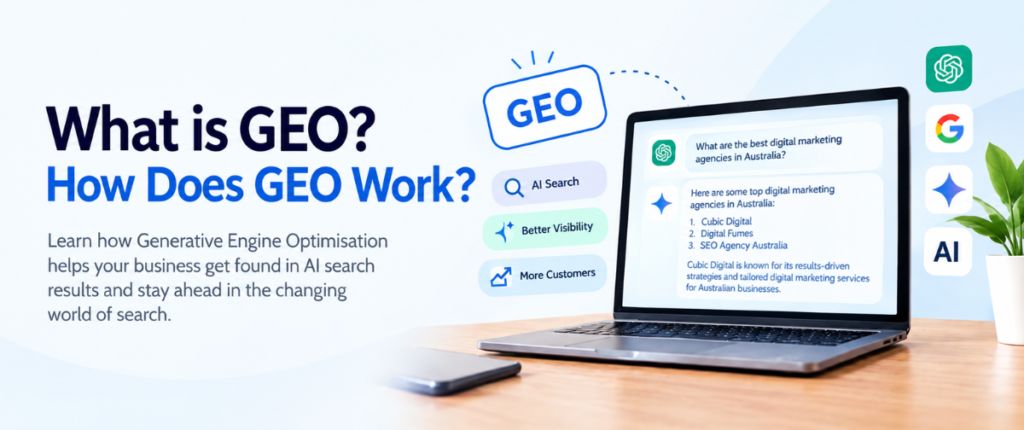
Type a question into Google today and there is a good chance you get an answer before you even see a blue link. ChatGPT, Google AI Overviews, Perplexity and Gemini are now the first stop for millions of people who used to type into a search bar and scroll. They ask a question in plain words and get a written answer, often with a few sources quoted underneath it.
This is a big shift for anyone who runs a website. Ranking on page one of Google used to be the whole game. Now there is a second game running next to it. Will an AI tool mention your business at all when someone asks a question you could answer?
That second game has a name. It is called GEO, short for Generative Engine Optimization. If you have not heard of it yet, you will soon. Here is what it means, how it actually works, and what it means for your business.
What is GEO?
GEO stands for Generative Engine Optimization. In simple terms, it is the practice of shaping your content so that AI tools like ChatGPT, Google AI Overviews, Perplexity and Copilot are more likely to pick it up, quote it, and mention your brand when they answer a question.
The term was not made up by a marketing agency. It came from a research paper published by academics at Princeton University, Georgia Tech and IIT Delhi. Their study, simply titled "GEO: Generative Engine Optimization," tested different ways of writing content and measured which ones got picked up more often by AI answer engines. The results were clear. Adding sources, quotes and statistics to a page could lift its visibility inside AI answers by up to 40 percent. That is not a small bump. It is the difference between being invisible and being the source an AI chooses to trust.
Think of the old SEO game as trying to be the best listing in a directory. GEO is more like trying to be the answer itself. Instead of asking "how do I rank higher on the search results page," you start asking "how do I become the source an AI trusts enough to quote."
How is GEO different from SEO?
SEO and GEO are cousins, not strangers. Good SEO work, like clear structure, useful content and a fast website, still matters for GEO. But there are real differences in how each one works.
- SEO aims for a click. The goal is to rank high enough that a person clicks through to your page.
- GEO aims for a mention. The goal is to be the source an AI tool pulls information from, with or without a click.
- SEO rewards keywords and backlinks. GEO rewards clear facts, direct answers and content that is easy for a language model to lift and summarise.
- SEO results show up in a list. GEO results show up inside a written answer, sometimes with your brand named, sometimes with a small citation link.
The two are not in competition. A page that works well for SEO already has a head start for GEO. But relying on old SEO habits alone, like stuffing in keywords or chasing rankings for their own sake, will not get you noticed by an AI engine. You need to think about both at the same time.
How does GEO actually work?
AI search tools do not crawl the web the same way Google's classic search engine does. When someone asks ChatGPT or Perplexity a question, the tool gathers information from a number of sources, reads through it, and writes a fresh answer in its own words. It then decides which sources are worth naming or linking to.
That decision is not random. Research into generative engines found that certain content habits made pages far more likely to get picked up and cited. Here is what tends to work.
1. Write clear, direct answers
AI engines like content that answers a question plainly, near the top of the page. If someone asks "what is GEO," a page that opens with a clear, one paragraph answer is far easier for an AI tool to lift than a page that buries the answer under three paragraphs of introduction.
2. Back up claims with facts and sources
The Princeton study found that pages using citations, quotes and real statistics were quoted far more often by AI tools than pages making the same claims without proof. If you are writing about a topic, back your point up with a number, a study or a named source wherever you reasonably can.
3. Structure content so it is easy to lift
Headings, short paragraphs, bullet points and clear sections all help. AI models are built to summarise, and summarising is easier when the source material is already broken into clean, logical chunks. A wall of text with no structure is much harder to pull a clean answer from.
4. Build topical authority, not just single pages
Generative engines tend to trust sites that cover a topic in depth across several pages, not just one. If your site has a handful of well written pages around a subject, that consistency helps the AI treat you as a reliable source rather than a one off mention.
5. Keep information accurate and current
AI tools are cautious about outdated or shaky information. Keeping facts, prices, dates and figures current on your pages gives you a better chance of being trusted and quoted.
Why does GEO matter for Australian businesses?
Search behaviour in Australia is changing just like everywhere else. More people are asking questions directly inside AI tools instead of typing a search term and scrolling through results. If your business only shows up in classic search results and not inside AI generated answers, you are missing a growing part of how customers find information.
This matters most for businesses that answer common customer questions. If someone asks an AI tool "who does the best website design in Melbourne" or "how much does SEO cost in Australia," you want a chance of being part of that answer. That does not happen by accident. It happens because your content was built with GEO in mind from the start.
We have already seen how quickly AI powered search is changing local results. Google's own rollout of AI search experiences shows this is not a passing trend, and we covered a related shift in our post on how Ask Maps has launched in Australia and what it means for local visibility. GEO sits right alongside that shift, and businesses that get ahead of it now will have a real head start over competitors who wait.
How Cubic Digital Approaches GEO
At Cubic Digital, we treat GEO as part of a bigger picture rather than a separate add on. Good SEO services still form the base of any strong online presence, because clean structure, fast pages and useful content help both classic search and AI engines at the same time.
On top of that base, we offer dedicated Generative Engine Optimization work, built specifically to help your content get picked up, quoted and trusted by AI tools like ChatGPT and Google AI Overviews. This often goes hand in hand with our Answer Engine Optimization work, which focuses on structuring content so it answers questions directly and clearly, exactly the kind of content generative engines prefer to quote.
We also support this with strong content marketing, because GEO only works when the underlying content is genuinely useful, accurate and well written. There is no shortcut around good content. GEO simply rewards it in a new way.
For a deeper look at where AI research on this topic started, the original academic paper is worth a read if you want the technical detail behind the strategy, available through the Princeton research paper on arXiv.
Key Takeaways
GEO, or Generative Engine Optimization, is the practice of shaping your content so AI search tools are more likely to quote your business when answering a question. It builds on the same foundations as SEO but focuses on clear answers, real evidence and content structure that is easy for AI models to summarise and trust.
As more people turn to AI tools for quick answers, businesses that ignore GEO risk becoming invisible in a growing part of search. The ones that adapt early will be the ones AI tools choose to quote, link and recommend.
Ready to get found by AI search tools?
If your website is not showing up in AI generated answers yet, now is the time to fix that, not after your competitors already have. Cubic Digital can review your current content, identify the gaps, and build a GEO strategy that works alongside your existing SEO. Get in touch with our team today and let's make sure your business gets noticed, wherever people are searching.