Google Search is changing how people find information online. Instead of browsing several websites, users can now get answers directly through Google's AI Overviews and AI Mode.
For Australian businesses, this creates a new challenge. Your website might appear in an AI-generated answer without receiving a click. Traditional SEO reports may not give you a clear picture of this visibility.
Until recently, website owners had limited information about how often their pages appeared in Google's AI-generated results.
That changed in June 2026 when Google introduced dedicated Search Generative AI performance reports in Google Search Console.
The reports give website owners a clearer view of how their content appears in Google's AI search features. They also help businesses identify which pages are gaining visibility and where there may be opportunities to improve.
In this guide, we explain how the new reports work, where to find them, what they measure, and how Australian businesses can use the data to improve their SEO strategy.
What Are Google Search Console AI Reports?
Google Search Console AI Reports are a new reporting feature that shows how often pages from your website appear in Google's generative AI search experiences.
Google officially announced these reports on 3 June 2026, initially making them available to selected websites. According to Google's official announcement, the rollout was completed worldwide on 31 August 2026.
The reports cover visibility in:
- Google AI Overviews: AI-generated summaries that appear for certain Google searches and may include links to supporting websites.
- Google AI Mode: A conversational search experience that allows users to ask detailed questions and follow-up questions.
- Google Discover AI Features: AI-generated content experiences within Google Discover, measured through a separate report.
Previously, AI search impressions were included in broader Search Console performance reporting. The new reports provide a dedicated view of this activity.
For example, an Australian accounting firm might publish an article about small business tax deductions. If Google includes a link to that article in an AI-generated response, the new report can record an impression when Google's counting conditions are met.
This helps the business understand whether its content is appearing in AI search results, even when users do not visit the website.
Google's official announcement: Introducing Search Generative AI Performance Reports.
Why AI Search Visibility Matters for Australian Businesses
Businesses have traditionally measured SEO success through keyword rankings, organic traffic, impressions, and enquiries.
These metrics remain important, but AI-generated search results add another layer to how people discover businesses.
A user searching for "best digital marketing strategies for small businesses in Australia" may receive an AI-generated answer that explains several marketing approaches and includes links to supporting websites.
Some users may visit those websites. Others may get enough information from the AI response without clicking anything.
This means a website can gain exposure through Google Search without seeing an equivalent increase in organic traffic.
AI Search Is Changing How Visibility Is Measured
Research from Pew Research Center, published in July 2025, found that users clicked a traditional search result in 8% of visits where an AI summary appeared, compared with 15% of visits without an AI summary.
The study examined Google browsing behaviour among US adults. While these findings should not be treated as Australian market figures, they help explain why businesses need to look beyond website clicks when measuring search performance.
Source: Pew Research Center.
For Australian businesses, tracking AI visibility can help answer questions such as:
- Are our website pages appearing in Google's AI-generated results?
- Which service pages and articles receive the most AI impressions?
- Are we gaining visibility among Australian search users?
- Is our AI search visibility increasing over time?
- Which content areas deserve further investment?
The new reports provide useful information for answering these questions, although they do not provide a complete picture of AI search performance.
How to Access Generative AI Reports in Google Search Console
If your website is verified in Google Search Console, you can check whether the new reporting feature is available.
Follow these steps:
- Sign in to Google Search Console.
- Select the website property you want to review.
- Open the Performance section.
- Expand Search results.
- Select Generative AI.
- Choose a date range, such as the last 28 days or three months.
- Review the impressions chart and available filters.
The report displays your website's generative AI impressions and provides information about the pages, countries, devices, and dates associated with those impressions.
What Does the Report Look Like?
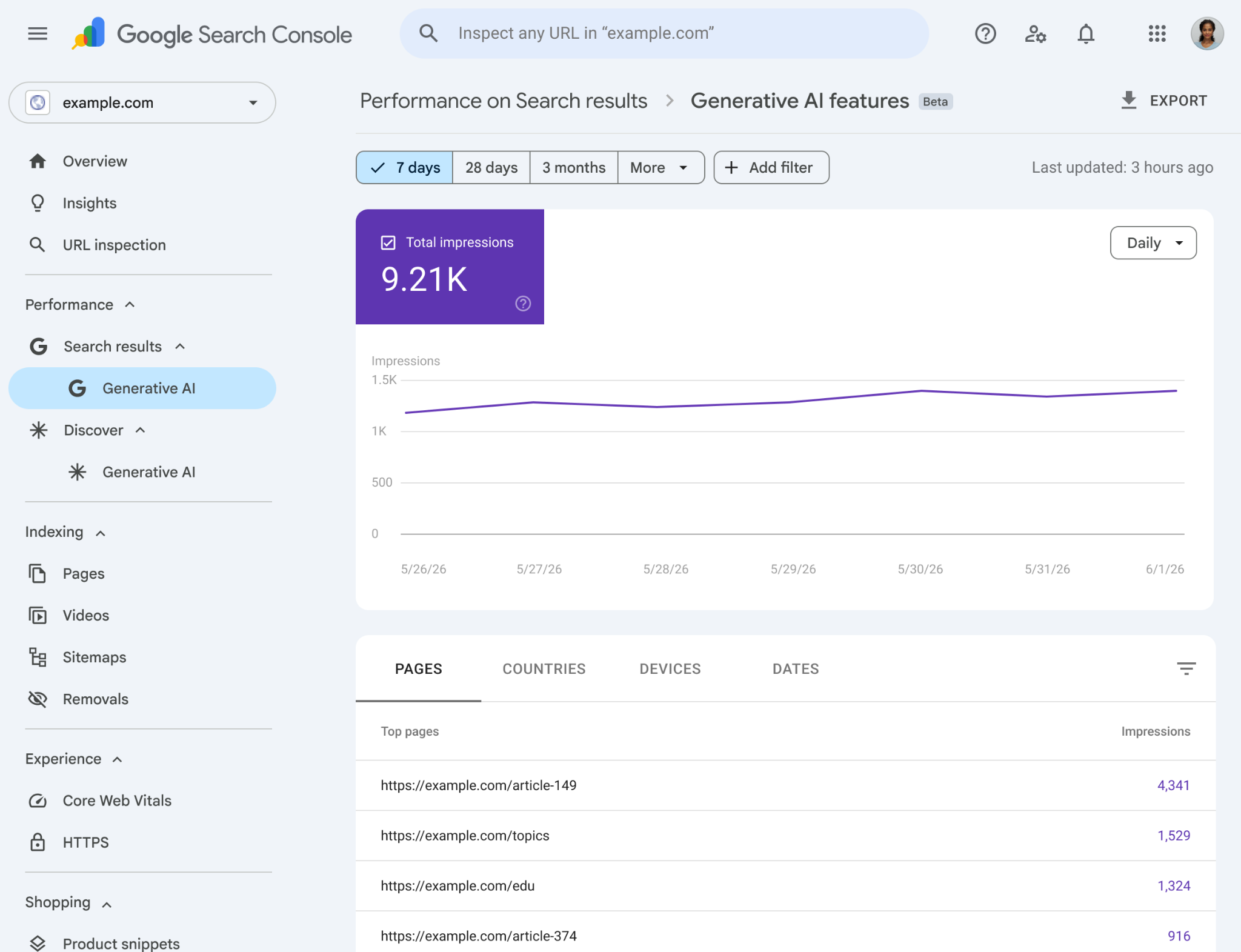
Source: https://developers.google.com/static/search/blog/images/generative-ai-features-performance-report.png
The example screenshot shows a website with approximately 9,210 generative AI impressions over a seven-day period.
Below the chart, the report lists pages that appeared in AI-generated search results, along with their recorded impressions.
These figures are illustrative and should not be presented as results achieved by Cubic Digital or its clients.
What if the report is missing?
Google states that the report may not appear when a website has not received enough impressions from generative AI features.
A missing report does not automatically mean your website has an indexing problem or that Google has excluded all your content from AI search.
Check your website's indexing status and AI search eligibility before making changes.
What Data Can You Track in Google Search Console AI Reports?
The new reports focus on impressions and allow website owners to examine their visibility from several angles.
| Metric | What It Tells You | How Businesses Can Use It |
|---|---|---|
| AI Impressions | How often your website appears in Google's generative AI features | Monitor overall AI search visibility |
| Pages | Which website URLs receive AI impressions | Identify content performing well in AI search |
| Countries | Where AI impressions originate | Measure visibility in Australia and other target markets |
| Devices | Which devices are associated with AI impressions in Search | Compare mobile and desktop visibility |
| Dates | How impressions change over time | Monitor trends and assess content improvements |
1. AI Impressions
AI impressions are the main metric available in the new reports.
They show how often URLs from your website appear in Google's generative AI search features, based on Google's impression-counting rules.
For example, if your website records 3,000 AI impressions in September and 4,200 in October, it indicates that recorded visibility has increased.
However, impressions are not the same as unique users, website visits, or leads.
An increase in impressions does not necessarily mean more people clicked through to your website.
2. Pages Receiving AI Impressions
The Pages section identifies which URLs are appearing in AI search features.
This can help you understand whether Google is surfacing your blog posts, service pages, guides, or other content.
For example, a digital marketing agency may find that its detailed SEO guides receive more AI impressions than its homepage.
This information can help guide future content planning.
Review pages with strong AI visibility and consider whether they offer clear answers, useful examples, relevant internal links, and suitable next steps for potential customers.
3. Country-Level Visibility
The Countries report is particularly useful for Australian businesses.
A company serving customers in Sydney, Melbourne, Brisbane, Perth, or across Australia can review how many AI impressions come from Australian searches.
For businesses serving multiple countries, this data can also help compare international visibility.
However, country-level reporting does not show precise city-level performance or reveal every search that triggered an AI-generated response.
4. Device Performance
The Devices section helps website owners understand whether impressions come from mobile, desktop, or tablet searches.
This can highlight differences in where your content appears.
For example, if mobile impressions are increasing, review whether your website provides a good mobile experience, including readable content, clear navigation, and fast-loading pages.
A responsive website design helps visitors access information easily across different screen sizes, particularly when they move from an AI-generated answer to your website.
5. Performance Over Time
The date filters allow you to monitor AI visibility across different periods.
You can compare recent performance with earlier results and identify changes after publishing new content or improving existing pages.
However, avoid judging an SEO change based on only a few days of data.
Search demand, Google's systems, and the topics people search for can all affect impressions.
For more reliable analysis, compare consistent reporting periods and review the changes alongside your wider SEO performance.
What Google Search Console AI Reports Do Not Show
Although the new reports are useful, they have several important limitations.
As of October 2026, the dedicated Generative AI reports do not provide:
- AI-specific clicks: You cannot see exactly how many users clicked your website from these AI features.
- Click-through rate: The report does not provide a dedicated CTR metric.
- Search queries: You cannot identify the exact questions or keywords responsible for each AI impression.
- Individual AI feature breakdowns: The Search report does not provide a separate impression total for AI Overviews versus AI Mode.
- Conversions: You cannot see how many enquiries or sales resulted directly from those impressions.
- Complete brand mentions: The report does not measure every time an AI system mentions your business without linking to your website.
These limitations matter when preparing SEO reports.
For example, a business might receive 10,000 AI impressions in one month. That does not mean 10,000 people visited its website or that those impressions generated enquiries.
AI impressions measure visibility, not business results.
For a better understanding of performance, businesses should combine Search Console data with website analytics, conversion tracking, and other AI visibility measurements.
How to Measure AI Search Visibility Beyond Google Search Console
Google Search Console is a useful starting point, but it cannot measure every way customers discover a business through AI.
People may also find businesses through ChatGPT, Microsoft Copilot, Perplexity, and other AI-powered platforms.
A more complete reporting approach uses several sources.
Google Analytics 4: Track Visits From AI Platforms
Google Analytics 4 can help identify visits that come from recognised AI assistants.
In GA4, open Reports > Acquisition > Traffic acquisition and review the available channel and source information.
Where supported, the AI Assistant channel can help identify visits from recognised AI platforms.
You can also examine referral sources and create suitable custom reports to review traffic from AI services.
Important metrics include:
- Sessions from AI assistants
- Engaged sessions
- Landing pages
- Key events and conversions
- Enquiries or purchases from identifiable AI referrals
Keep in mind that not every AI-driven visit can be identified. Some visits may be recorded under Direct or another channel because referral information is unavailable.
Bing Webmaster Tools: Review AI Citations
Bing Webmaster Tools provides an AI Performance report that can help website owners understand how their content is cited in supported Microsoft AI search experiences.
This provides a different perspective from Google's impression-based reporting.
It can help you identify content receiving citations and monitor changes over time.
Track Important Questions Manually
Businesses can also test how AI platforms respond to common customer questions.
For example, a Sydney-based business might monitor questions such as:
- What should a small business look for when choosing an SEO agency in Sydney?
- How much does local SEO cost in Australia?
- How can Australian businesses improve their Google Maps visibility?
- What is the difference between SEO and AI search optimisation?
Record whether the business is mentioned, whether its website is linked, and which competitors appear.
Because AI-generated answers can change between searches, repeat the same questions and use a consistent method.
Manual testing should be treated as a sample, not a complete measurement of AI visibility.
How Australian Businesses Can Use AI Search Data to Improve SEO
Collecting impressions is only the first step. The real value comes from using that information to improve your website and content.
Here are six practical actions businesses can take.
1. Identify Pages Already Appearing in AI Results
Start with the Pages report.
Look for content that receives regular AI impressions and review what makes those pages useful.
They may provide detailed answers, explain specific topics, or cover questions relevant to your audience.
For example, a business offering SEO services may find that an article explaining technical SEO receives more AI impressions than a general service overview.
Rather than rewriting successful content without a reason, look for opportunities to improve accuracy, add helpful examples, and guide readers towards relevant services.
2. Improve Pages With Useful Information
AI search visibility does not require a completely separate website or a new set of ranking tricks.
Start by improving the quality and usefulness of your existing content.
Consider adding:
- Clear answers to common customer questions
- Practical examples based on real business situations
- Relevant statistics with reliable sources
- Accurate service information
- Helpful comparisons and explanations
- Descriptive headings and logical content sections
- Author details and appropriate supporting references
For example, an article about SEO costs in Australia could explain what affects pricing, what services are usually included, and what businesses should ask before choosing a provider.
Content that genuinely helps readers make decisions is more valuable than pages created simply to repeat keywords.
Google's approach to evaluating helpful content places importance on experience, expertise, authoritativeness, and trustworthiness. Understanding E-E-A-T and its relationship with Google rankings can help businesses create content that offers real value to readers.
3. Review Your Existing Keyword Strategy
Traditional keyword research remains important, but businesses should also consider the questions behind those searches.
Someone searching for "local SEO Australia" may be researching a service.
Another person asking "why is my business not appearing on Google Maps?" has a specific problem they want to solve.
Both searches can provide content opportunities, but they require different answers.
Use Google Search Console's regular search performance data to identify relevant queries, then build content around the needs behind those searches.
The new AI reports do not provide query-level data, so do not assume a particular keyword caused an AI impression.
4. Strengthen Internal Linking and Website Navigation
Internal links help visitors discover related information and allow search engines to understand connections between your website pages.
For example, a business publishing detailed guides about search performance should make it easy for readers to move between related topics, supporting resources, and relevant service information.
Use descriptive anchor text that explains what readers can expect when they follow a link.
Internal links should fit naturally within the content rather than being added only for SEO purposes.
Clear website navigation also helps visitors find the information they need without unnecessary steps.
5. Maintain Strong Technical SEO
Even helpful content can struggle to perform if search engines cannot access or understand it.
Review the technical foundations of your website, including:
- Crawlability and indexing
- Correct canonical URLs
- XML sitemaps
- Mobile usability
- Page speed and Core Web Vitals
- Clear page titles and headings
- Relevant structured data where supported
- Accurate internal links
Structured data can help Google understand eligible page information, but it does not guarantee inclusion in AI Overviews or AI Mode.
A strong SEO strategy should continue to address technical issues, content quality, and website usability while also monitoring visibility in AI-powered search.
6. Measure Visibility Alongside Enquiries and Sales
An increase in AI impressions is encouraging, but it should not become the only measure of success.
A local service business may receive fewer impressions than a national publisher while generating more valuable enquiries.
Review AI visibility alongside:
- Organic search traffic
- Search rankings
- Website enquiries
- Phone calls
- Form submissions
- Conversion rates
- Revenue where available
This helps keep SEO reporting focused on business outcomes rather than impressions alone.
Example: How an Australian Business Could Review Its AI Search Performance
Consider a hypothetical Melbourne-based accounting business that publishes guides about tax planning, bookkeeping, and business expenses.
After checking its Google Search Console AI report, it records the following results.
| Metric | September 2026 | October 2026 |
|---|---|---|
| AI Impressions | 2,500 | 3,400 |
| Pages with AI Impressions | 12 | 16 |
| Australian AI Impressions | 1,800 | 2,600 |
| Organic Website Enquiries | 22 | 25 |
Note: These figures are fictional and provided only to demonstrate the reporting process.
The business can see that AI impressions have increased and that more pages are appearing in AI-generated search results.
It can also see an increase in organic enquiries.
However, the data does not prove that the additional enquiries came from AI search.
The next step would be to examine the pages receiving impressions, compare organic landing-page performance, and review identifiable AI referral traffic in GA4.
This approach gives the business a more balanced understanding of its online visibility.
How Often Should You Review Google Search Console AI Reports?
For most Australian small and medium-sized businesses, a monthly review is a practical starting point.
A monthly report provides enough time to observe trends without reacting to every short-term change.
Here is a simple reporting schedule:
| Frequency | Recommended Action |
|---|---|
| Weekly | Check for major changes in AI impressions and website performance |
| Monthly | Compare AI impressions, leading pages, countries, and organic conversions |
| Quarterly | Review content priorities, technical SEO, and wider AI search visibility |
When reviewing results, keep a record of major website changes, newly published articles, and content updates.
This makes it easier to understand what changed, although it does not prove that a particular update caused an increase in impressions.
Why Reliable AI Search Reporting Matters
AI tools are becoming more common in marketing, but businesses still need reliable information before making decisions.
A 2026 marketing data survey involving 435 marketers across Australia, the US, UK, Germany, and Singapore found that only 18% reported high trust in AI.
The finding highlights the importance of using verified data and being clear about what each report can measure.
For SEO teams, this means avoiding claims that AI impressions directly represent clicks, customers, or revenue.
Instead, reporting should explain what the data shows, what remains unknown, and which actions may help improve results.
Australian businesses do not need complicated dashboards to get started. A clear monthly report combining Google Search Console, GA4, and relevant business outcomes can provide a useful foundation.
What Does the Future of AI Search Reporting Look Like?
Google's introduction of dedicated Generative AI reports is an important development for website owners.
It provides more direct information about how websites appear in AI-generated search experiences.
However, reporting is still developing.
Businesses would benefit from additional information about clicks, search queries, and the individual AI features responsible for impressions.
Google has acknowledged interest in further metrics, but there is no confirmed timetable for these additions.
For now, businesses should use the available information while continuing to improve their websites for both traditional search and AI-powered discovery.
As explained in our article on how AI is changing Google Search, businesses need to consider how users discover information through both standard search results and AI-generated answers.
Understanding these changes can help businesses make better decisions about content, website improvements, and future marketing investment.
Final Thoughts
Google Search Console's new AI performance reports give Australian businesses a better way to understand how their websites appear in AI-generated search results.
They provide valuable information about impressions, pages, countries, devices, and performance trends.
However, AI impressions alone cannot tell you how many customers visited your website or made an enquiry.
The best approach is to combine AI visibility data with traditional SEO reporting, website analytics, and conversion tracking.
Businesses that regularly review this information can make better decisions about content, technical SEO, and future marketing investment.
As Google Search continues to develop, maintaining a helpful, trustworthy, and technically sound website remains one of the most practical ways to support long-term search visibility.
Need Help Improving Your Website's Visibility in AI Search?
At Cubic Digital, we help Australian businesses improve their online visibility through SEO, content marketing, and AI search optimisation.
Whether you want to understand your Google Search Console data, improve your website content, or strengthen your presence in AI-powered search results, our team can help you develop a practical strategy based on your business goals.
Find out how our AI search optimisation services can support your business, or speak with our team about improving your website's search performance.
Frequently Asked Questions
Can Google Search Console Track AI Overview Impressions?
Yes. Google Search Console's Generative AI performance report shows impressions from supported AI search features, including AI Overviews and AI Mode. However, it does not provide a separate impression total for each feature.
Does Google Search Console Show Clicks from AI Overviews?
The dedicated Generative AI report does not currently show clicks or click-through rates. Website owners can review overall search performance and use Google Analytics 4 to measure identifiable website visits.
Is the Google Search Console AI Report Available in Australia?
Yes. Google completed the worldwide rollout of its Generative AI performance reports on 31 August 2026. However, a report may not appear for websites without enough eligible AI impressions.
How Can I Improve My Website's Visibility in Google AI Overviews?
Focus on useful, accurate, well-organised content that answers relevant questions. Maintain strong technical SEO, ensure important pages can be indexed, and support your content with trustworthy information. No SEO technique can guarantee inclusion in AI Overviews.
Can I Track ChatGPT Visibility Through Google Search Console?
No. Google Search Console reports on Google's search experiences, not brand mentions or citations within ChatGPT. You can review identifiable ChatGPT referral visits in GA4 and use separate methods to monitor mentions and citations.
What Is the Difference Between SEO and AI Search Optimisation?
SEO focuses on improving website visibility in search engines. AI search optimisation also considers how content is discovered, understood, and referenced within AI-generated answers.
Although these approaches share many foundations, there are important differences between SEO, AEO, and GEO that businesses should understand when planning their search strategy.
Are AI Impressions More Important Than Organic Traffic?
Both provide useful information, but they measure different things. AI impressions show exposure within supported AI search features. Organic traffic shows visits to your website. Businesses should consider both alongside enquiries, conversions, and other commercial outcomes.