For twenty years, local search worked one way. Someone typed "plumber near me", Google showed three businesses in a map pack, and your job was to be one of them.
That is no longer the only path to a customer.
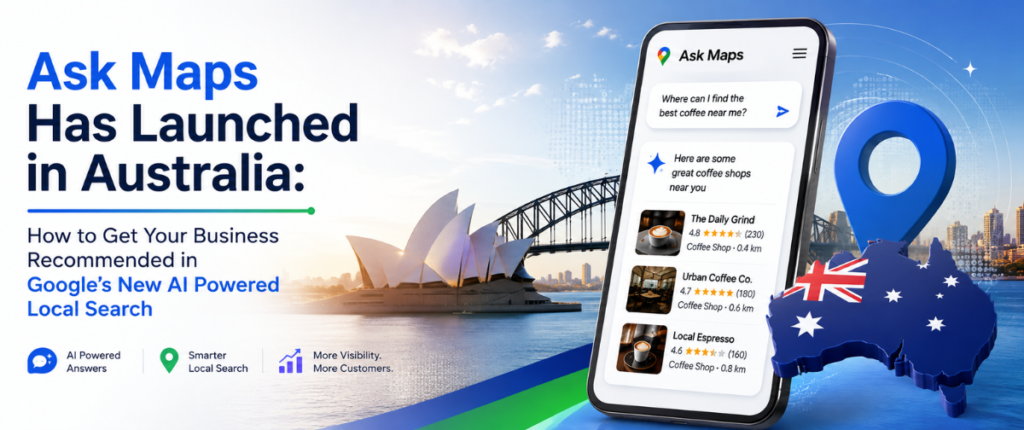
On 6 August 2026, Google confirmed that Ask Maps is rolling out in Australia in English. Google describes it as the biggest transformation to Google Maps in over a decade. Instead of matching a keyword to a list of pins, Ask Maps holds a conversation and answers real world questions using Gemini.
For Australian businesses that depend on local customers, this is the most significant change to local discovery since the map pack itself.
What Ask Maps actually does
Ask Maps sits underneath the search bar inside Google Maps. You can type or speak a question, and it interprets the whole request rather than picking out keywords.
Google's own Australian example is asking whether there is a ferry to Taronga Zoo with views of the Opera House and when the next one leaves. The answer comes back as options at a glance, including live delay alerts.
The Australian rollout includes several capabilities worth understanding:
- A live transit board that updates automatically, so public transport answers stay current
- Real time disruption alerts along a driving route, covering things like crashes and construction
- Busyness on demand, so someone can ask how busy a place is right now and time their visit
- Personal Intelligence with Gmail, which lets Ask Maps factor in an upcoming flight or dinner booking when making suggestions
Personal Intelligence is off by default and requires the user to connect their account deliberately. Calendar support is coming.
Australia is part of a broader expansion. Google's global announcement confirms Ask Maps rolling out to Australia, Brazil, Canada, Indonesia, Japan and Mexico, along with more than 150 countries and territories in English, alongside new agentic capabilities that can handle multi step tasks. Some of those, including conversational food ordering, are starting in the United States first.
Ask Maps itself is not brand new. It launched in March 2026 in the United States and India, alongside a redesigned Immersive Navigation view. Australia has now joined that rollout.
Why this changes local visibility
The map pack shows three businesses. A conversational answer often names one or two, and sometimes none.
That is the whole story in one sentence. Attention concentrates.
There is a second difference that matters more for how you work. A keyword search asks a simple question and gets a ranked list. A conversational query stacks conditions on top of each other. Someone might ask for a physio in Werribee who bulk bills, has parking, and can see them after work on a Thursday.
To answer that, the system needs specific facts about your business. Not a well optimised page title. Actual attributes, hours, service details and customer language.
If those facts are missing from your Google Business Profile, you are not ranked lower. You are filtered out of consideration entirely, because the system cannot confirm you meet the conditions.
That is a meaningfully different failure mode, and it rewards completeness over cleverness.
What Australian businesses should fix first
The good news is that none of this requires a new strategy. It requires finishing the one most businesses started and abandoned.
Complete every field on your Google Business Profile
Go through the profile properly, not the four fields you filled in when you claimed it.
- Primary category, chosen precisely, plus every genuinely relevant secondary category
- Full service list with descriptions, not just service names
- Attributes such as parking, accessibility, payment methods, appointment requirements and languages spoken
- Opening hours, including public holiday hours, which almost nobody keeps current in Australia
- Service areas for businesses that travel to customers
- Products where relevant, with real prices
Every one of those fields is a condition an AI answer can check you against. Empty fields are silent disqualifications.
Treat reviews as content, not a score
A star rating is a number. Review text is evidence.
When a customer writes that your team arrived on time in Point Cook and fixed a hot water system the same day, that sentence contains a service, a suburb and an outcome. That is exactly the kind of detail a conversational system can draw on when someone asks a specific question.
Practical steps:
- Ask for reviews consistently rather than in one big push every two years
- Encourage detail by asking customers what job you did rather than asking for five stars
- Respond to every review, including the difficult ones, using natural language that names the service
- Keep them coming. Recency reads as an active business
Make your website agree with your profile
Your business name, address, phone number and opening hours need to match everywhere they appear. Your site, your profile, your directory listings and your social pages.
Inconsistency creates doubt, and a system that cannot confirm a fact tends to leave it out. This is unglamorous work and it is still the highest value hour most local businesses can spend.
Structured data helps here too. LocalBusiness and Service markup on your website states your details in a form that machines read without interpretation.
Answer the questions people actually ask
Most Australian service websites list what they do. Very few answer what customers want to know before they call.
Do you charge a call out fee. How soon can you come. Which suburbs do you cover. Do you work weekends. What does a typical job cost.
Putting those answers in plain text on your site gives both traditional search and conversational search something concrete to work with. It also happens to be what a nervous customer wants at 9pm on a Sunday, which is the better reason to do it.
Keep the map pack in perspective
None of this means the traditional map pack has stopped mattering. It has not.
Most local searches in Australia still run through the standard experience, and the map pack still delivers the call button that turns a search into a phone call. Ask Maps adds a second path to discovery rather than replacing the first one.
What has changed is that the same underlying assets now serve both. A complete profile with detailed reviews and consistent business data wins in the map pack and gives conversational search something to recommend. There is no separate optimisation track to build.
The businesses that will struggle are the ones with a half finished profile, forty ratings from 2022 and no review text worth reading. They were already fragile. Ask Maps just makes the consequence sharper.
Worth noting for context: DataReportal's Digital 2026 Australia report counted 26.2 million Australians online at the end of 2025, at 97.1 per cent penetration. Your customers are all there already. The only question is whether Google can confidently name you when they ask.
We covered the broader shift toward AI generated answers in our earlier piece on how AI is changing Google Search, which is worth reading alongside this if the change is new to you.
Where to start this month
If you do nothing else, do these three things:
- Open your Google Business Profile and fill every empty field, including attributes and holiday hours
- Ask your last twenty customers for a review, and ask them to mention the job and the suburb
- Check that your name, address, phone and hours match across your site and your listings
That is a weekend of work for most businesses, and it is the foundation for everything that follows.
Cubic Digital manages local search visibility for businesses across Australia, from single location trades and clinics through to multi site operators. We audit the profile, rebuild the data, run the review program and keep the details consistent everywhere they appear. It sits alongside the broader organic search work rather than separate from it.
If you are not sure how your business looks to Google right now, get in touch and we will take a look at your profile with you.